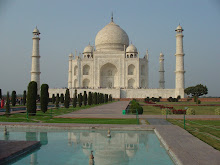
History of Taj Mahal
Experiencing the Taj Mahal without being cognizant of its history is grossly irrelevant and absurd. The extravagant expression has not come easy. There underlays an ocean of emotions and a wild passion that led the king to erect such a masterpiece in snow-white marble. It's a monument, the only one, where perhaps, ever inch of the edifice, from one corner to the other, expresses the beauty of Mumtaz Mahal. Mughal emperor's Shah Jahan's intense feelings and warmheartedness can be felt at the very first instant as you arrive here to fix your gaze upon one of the most phenomenal structures in the world. History of Taj mahal
The splendid love story begins in 1612, when a Persian princess Arjumand Bano married Shah Jahan (then prince Khurram), the fifth Mughal emperor. Arjumand Bano, who later became known as Mumtaz Mahal (the Chosen of the Palace), was a second wife to the emperor. Both a companion and an advisor, the queen followed the emperor on his journeys and military expeditions. Such was the effect of the queen on his emperor-husband that Shah Jahan was inspired to perform acts of charity and benevolence all throughout his life.
Book Your Tour to Taj Mahal The love story took a serious turn when, on a campaign at Burhanpur with her husband, Mumtaz Mahal took his last breath giving birth to their 14th child. So heartbroken was the emperor that the whole court went into mourning for a span of over two years. It is said that, within a few months after the queen's death, the hair and beard of the king had turned white. And Shah Jahan was recklessly determined on building a monument in his consort's loving memory that the world had never seen. The dead body of the queen was brought to Agra and buried in a garden on the banks of river Yamuna. A group of the finest architects was assembled to devise a plan for erecting the tomb. Eventually, Ustad Isa, a Persian architect, was called upon to design the structure. The master architect along with his pupil Ustad Ahmad began the construction of the edifice. The dome, however, was fashioned by Ismail Khan. A total of 20,000 labourers from across the country and the world were employed to work for 22 years continuously. Finest of the marbles were procured from the district of Markana near Jodhpur. Precious and semi precious stones were brought from far off places. Later, the mausoleum was provided with luxuriant furnishings. Persian carpets and gold lamps embellished the interior of the Taj. Two silver gates, that were set up at the entrance, were taken away by Suraj Mal in 1764. Amir Husein Ali Khan looted the sheet of pearls that covered the stone coffins. It is said, that after the completion of the construction, when emperor Shah Jahan viewed the Taj, he ordered his men to cut off the right hand of the master architect Ustad Isa, so the later may not be able to erect such a stately and imposing edifice again in his life. There's another legend that says Shah Jahan was contemplating to build yet another Taj Mahal across the river in black marble. Now, it's up to you how many more legends you can make yourself aware of while on a trip to Agra, the city of the Taj. Get accompanied by a travel guide and begin exploring the myths and legends, poring over the glorious chapters of the history.
Sunday, September 26, 2010

Best Time to Visit Taj Mahal
Best Time to Visit Taj Mahal
Best Time to Visit: October to March (Winters)The best time to visit Taj Mahal revolves around the weather of Agra, the city of the Taj Mahal. As per the climate of Agra, the peak season for Taj Mahal visit is the winter season i.e., from October to March. Otherwise, there is no such thing as "the best time" to visit this magnificent monument. You may see Taj Mahal in any month of the year and it will come forward as breathtaking as it has always been. Infact, different seasons as well as different hours of the day lend a different aura to it.Visit the Taj in the morning and it will come up with a pinkish glow to it. As the day passes, the pinkish glow turns into milky white by the evening. However, the radiance of the Taj under the moonlight is beyond any explanation. The white marble adorned with semi-precious stones stands sparkling like a jewel. By now, we have answered your question of "when to visit Taj Mahal of Agra". Remaining is, how much time to spend there. We will suggest that spend at least a day at the Taj Mahal to capture its beauty fully.When visiting India browse through this beautiful list of places to see in India to make your trip a memorable one.
Best Time to Visit: October to March (Winters)The best time to visit Taj Mahal revolves around the weather of Agra, the city of the Taj Mahal. As per the climate of Agra, the peak season for Taj Mahal visit is the winter season i.e., from October to March. Otherwise, there is no such thing as "the best time" to visit this magnificent monument. You may see Taj Mahal in any month of the year and it will come forward as breathtaking as it has always been. Infact, different seasons as well as different hours of the day lend a different aura to it.Visit the Taj in the morning and it will come up with a pinkish glow to it. As the day passes, the pinkish glow turns into milky white by the evening. However, the radiance of the Taj under the moonlight is beyond any explanation. The white marble adorned with semi-precious stones stands sparkling like a jewel. By now, we have answered your question of "when to visit Taj Mahal of Agra". Remaining is, how much time to spend there. We will suggest that spend at least a day at the Taj Mahal to capture its beauty fully.When visiting India browse through this beautiful list of places to see in India to make your trip a memorable one.
Taj Mahotsav Agra
Taj Mahotsav Agra
Location: Shilpgram, Near Taj Mahal, AgraTime: FebruaryDuration: 10 daysOrganized by: Uttar Pradesh TourismSignificance: Celebrated to promote rich arts, crafts, culture, cuisine, dance and music of the stateHighlights: A procession taken out in the typical Mughal era style, food festival, performances by folk musicians and dancers, etcTaj Mahotsav is celebrated at Agra in the month of February for ten days. Organized by the Uttar Pradesh Tourism, the Taj Mahotsav is mainly dedicated to the promotion of Uttar Pradesh's rich arts, crafts, culture, cuisine, dance and music. Infact, it serves as an acknowledgment to the craftsmen as well as the exponents of art, music and cuisine. The venue of the festival of Taj Mahostav is Shilpgram, which is stone's throw away from Taj Mahal. The festival starts with a procession including bejeweled elephants and camels, drum beaters, folk artists and master craftsmen. This procession is an effort to reconstruct the ones that were taken out during the time of the Mughals. The crafts that are showcased in the festival have immense variety and include:
Woodcarvings of Saharanpur
Brass and other metal ware of Moradabad
Handmade carpets of Badohi
Blue pottery of Khurja
Chikan work of Lucknow
Silk of Banares, etc One of the major attractions of the Taj Mahal Utsav of Agra is the Food Festival, where you can get some of the oldest and the most typical delicacies from the interiors of Uttar Pradesh. Folk music and folk dances of Bundelkhand, 'Nautanki' (Drama), 'Sapera' dance of Rajasthan will further entertain you in this amazing festival.
History of Taj Mahal
History of Taj Mahal
The history of the Taj Mahal tells us "why was the Taj Mahal built" and many other myths and facts associated with this wonderful structure. Mughal Emperor Shah Jahan erected the Taj Mahal in the memory of his beloved wife, Mumtaz Mahal. Shah Jahan (then Prince Khurram) met Mumtaz Mahal (then Arjumand Banu Begum) at the age of fourteen and fell in love at the first sight. She was a Muslim Persian princess and Shah Jahan was the son of the Mughal Emperor, Jehangir. Five years later, in 1612, they got married. As you read further you will come to know more about the history of the Taj Mahal at Agra…Mumtaz Mahal, an inseparable companion of Shah Jahan, died in 1631, while giving birth to their 14th child. It is believed that during her last moments, Mumtaz Mahal obtained a promise from Shah Jahan that he will build world's most beautiful monument in her memory. But this has not been proven to be true, till date. However, Shah Jahan did indeed build a magnificent monument as a tribute to her wife, which we today know as the "Taj Mahal". Shah Jahan, himself also, lies entombed in this mausoleum along with his wife.The construction of Taj Mahal started in the year 1631 and it took approximately 22 years to build it. An epitome of love, it made use of the services of 22,000 laborers and 1,000 elephants. It was built entirely out of white marble, which was brought in from all over India and central Asia. After an expenditure of approximately 32 million rupees (approx US $68000), Taj Mahal was finally completed in the year 1653. However, the history of Taj Mahal of India still has some gaps. For example, there are many theories regarding the architect of this magnificent monument.
The history of the Taj Mahal tells us "why was the Taj Mahal built" and many other myths and facts associated with this wonderful structure. Mughal Emperor Shah Jahan erected the Taj Mahal in the memory of his beloved wife, Mumtaz Mahal. Shah Jahan (then Prince Khurram) met Mumtaz Mahal (then Arjumand Banu Begum) at the age of fourteen and fell in love at the first sight. She was a Muslim Persian princess and Shah Jahan was the son of the Mughal Emperor, Jehangir. Five years later, in 1612, they got married. As you read further you will come to know more about the history of the Taj Mahal at Agra…Mumtaz Mahal, an inseparable companion of Shah Jahan, died in 1631, while giving birth to their 14th child. It is believed that during her last moments, Mumtaz Mahal obtained a promise from Shah Jahan that he will build world's most beautiful monument in her memory. But this has not been proven to be true, till date. However, Shah Jahan did indeed build a magnificent monument as a tribute to her wife, which we today know as the "Taj Mahal". Shah Jahan, himself also, lies entombed in this mausoleum along with his wife.The construction of Taj Mahal started in the year 1631 and it took approximately 22 years to build it. An epitome of love, it made use of the services of 22,000 laborers and 1,000 elephants. It was built entirely out of white marble, which was brought in from all over India and central Asia. After an expenditure of approximately 32 million rupees (approx US $68000), Taj Mahal was finally completed in the year 1653. However, the history of Taj Mahal of India still has some gaps. For example, there are many theories regarding the architect of this magnificent monument.
Monday, June 16, 2008
HISTORY
In 1612, Arjumand Banu Begam, a Muslim Persian princess better known by her other name, Mumtaz Mahal was married to Shah Jahan (then Prince Khurram), the fifth Mughal emperor. Mumtaz, the emperor's second wife, was her husband's comrade and counselor. An inseparable companion on all his journeys and military expeditions, she inspired the emperor to do acts of charity and benevolence towards the weak and the needy.
Mumtaz bore 14 children, and when she died during childbirth in 1631, Shah Jahan was so heartbroken that all his hair and beard were said to have turned snow-white in a few months! Overpowered by grief, Shah Jahan decided to immortalize the memory of his beloved wife by building the finest sepulcher ever - a monument of eternal love. Herein lies the genesis of the Taj Mahal.
The construction documents show that its master architect was Ustad Ahmed Lahori, the renowned Islamic architect of his time. The much-celebrated saga of royal love was brought to life by dexterous and skilled artisans from places as far away as Delhi, Kannauj, Lahore, Multan, Baghdad, Shiraz and Bukhara.
Construction began in 1631, and over 20,000 workmen and master craftsmen worked laboriously for 22 years to give shape to the emperor's passionate dream! The material was brought in from all over India and central Asia and it took a fleet of 1,000 elephants to transport it to the site.
Subscribe to:
Posts (Atom)